The Missing Engagement: Building for the People Who Can't Pay
Founder & Principal Consultant · NIH CHORUS Co-Author
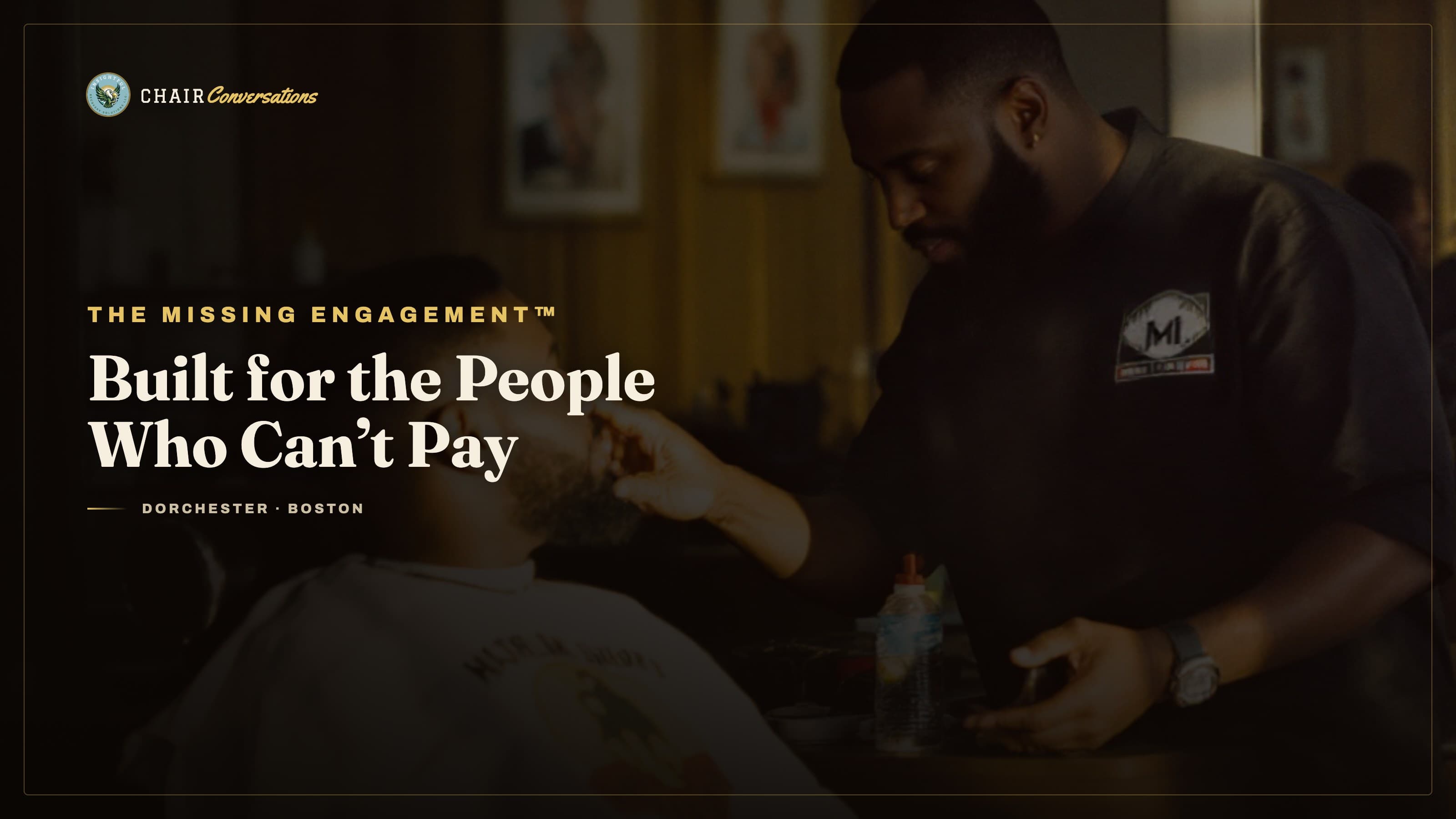
Most systems are built for the people who can already reach them.
You need a phone that works. A ride. An address. A day off. A reason to trust the person on the other side of the desk. Miss one of those and the whole thing might as well not exist. The care is real. The door is just too far from where the person is standing.
That gap has a name. We call it The Missing Engagement™ — the distance between what's offered and who can actually get to it. And the people living in that gap are not hard to reach because something is wrong with them. They're hard to reach because nobody built the road out to where they already are.
So we built one. It starts in a chair.
The Core Idea
- —The gap isn't in the people. It's in the road — the care exists, but most people can't actually reach it.
- —Nobody in that gap is empty. The healing is already in the room, waiting to be met where it lives.
- —The flip most programs miss: the free community group isn't the charity line. It's the whole product.
- —Funders pay for a trained, measured system. The community gets it free. That's the design, not a discount.
What the Missing Engagement Actually Is
Walk any neighborhood and you'll find people the system counts as “unreached.” Programs exist for them. Numbers get written about them. But between that person and their own healing sits a wall — the cost, the paperwork, the distance, the memory of the last time a system looked at them and saw a problem instead of a person.
That wall is Community Friction™ — everything standing between a community and the healing that's already theirs. It's not one thing. It's a hundred small ones stacked on top of each other until the only move left is to stop trying.
Here's what the field misses. On the other side of that wall, people are not empty. Every person carries Healing Capital™ — a wellspring of inner healing they already hold, that becomes their currency for living the moment they activate it on purpose. Nobody is broken. The healing is already in the room. The work is meeting it where it lives instead of asking it to travel to us.
The Math Most Programs Get Backwards
Now the part almost everyone gets backwards.
Most organizations treat the free community group as the leftover. The charity line. The thing you do when there's money left over after the “real” work is paid for. First to get cut, last to get counted.
We flipped it.
The free community group is not the leftover. It is the output. It is the product. It's the entire point of the machine. Funders, institutions, and partners pay for a trained, measured, replicable system — and the community gets that system free. The people who can't pay were never the problem to solve around. They are who the whole thing is built for.
That changes what you're actually selling to a funder. You're not asking them to sponsor a nice gesture. You're asking them to underwrite reach they cannot buy any other way — into rooms their outreach has never touched, through a person the community already trusts. The revenue and the reach are two different jobs, held by two different sets of hands. Nobody in the chair pays. That's not a discount. That's the design.
We build the paying side on purpose — an online membership community and an in-person program for people and organizations ready to invest at a deeper level. That's what keeps the lights on. But the engagement layer, the free group in the shop, stays free. Deliberately. It's the public good the paying side exists to protect.
Engagement Is the First Intervention
We have a rule that sits under all of it: Engagement Is The First Intervention™.
The field is trained to think the intervention is the program — the referral, the bed, the curriculum. But none of that reaches a person who never engaged in the first place. Before anyone gets to the “real” help, somebody has to actually reach them, in a place they already are, in a voice they already trust. That first moment of real contact isn't the warm-up. It's the treatment starting.
So the chair becomes the entry point. A man sits down for a cut and a conversation. No clipboard. No intake. Just a real exchange rooted in truth. And when he's ready for more — when something opens and he wants the next step — we don't hand him a flyer and wish him luck. We do the warm handoff. We hand him to a person, not a pamphlet. Because the missing engagement doesn't get closed by another brochure. It gets closed by someone who stays in the room.
Meeting Health Where It Already Lives
There's a line I keep coming back to.
“The barbershop has always been where Black men told the truth. We are not bringing health to the community — we are meeting health where it already lives.”
Read that slow, because it's the whole thesis. Most models assume health is something we carry in from the outside and deliver, like a package. Ours assumes the opposite. The health, the trust, the honesty, the Healing Capital — all of it is already there, in the shop, in the chair, in the room where people have told each other the truth for generations. We're not the source. We're the ones who finally showed up where the truth was already being told.
That's why it works where the clinic doesn't. We didn't build a new place and ask people to trust it. We went to the place they already trust.
Build It With Us
The Chair Conversations™ pilot runs four Mondays — July 20, July 27, August 3, and August 10, 2026 — at Flipping Clippers Barbershop, 483 Washington St, Dorchester, MA. Eighteen seats a session. Every session gets captured, measured, and built into the next one, so what a funder backs isn't a one-off event. It's the first proof of a system that repeats.
If you fund community health, recovery, or reentry, this is reach you cannot manufacture. You can pay for the road. The community walks it free. That's not a compromise on the mission. That is the mission.
Somebody has to build for the people who can't pay. Build it with us.
Fund the road. The community walks it free.
Sponsor The Chair Conversations™ pilot — four Mondays this summer in a Dorchester barbershop.
Sponsor the PilotDisclaimer: This content is not medical advice. Insightful Recovery Solutions provides non-clinical recovery support services. The information in this article is educational and peer-oriented — it does not replace professional medical care, therapy, or treatment. If you are experiencing a mental health crisis, thoughts of self-harm, or a medical emergency, call 988 (Suicide & Crisis Lifeline), contact SAMHSA's National Helpline at 1-800-662-4357, or go to your nearest emergency room.