Who Holds the Chair: Why Barbers & Cosmetologists Are Recovery Assets
Founder & Principal Consultant · NIH CHORUS Co-Author
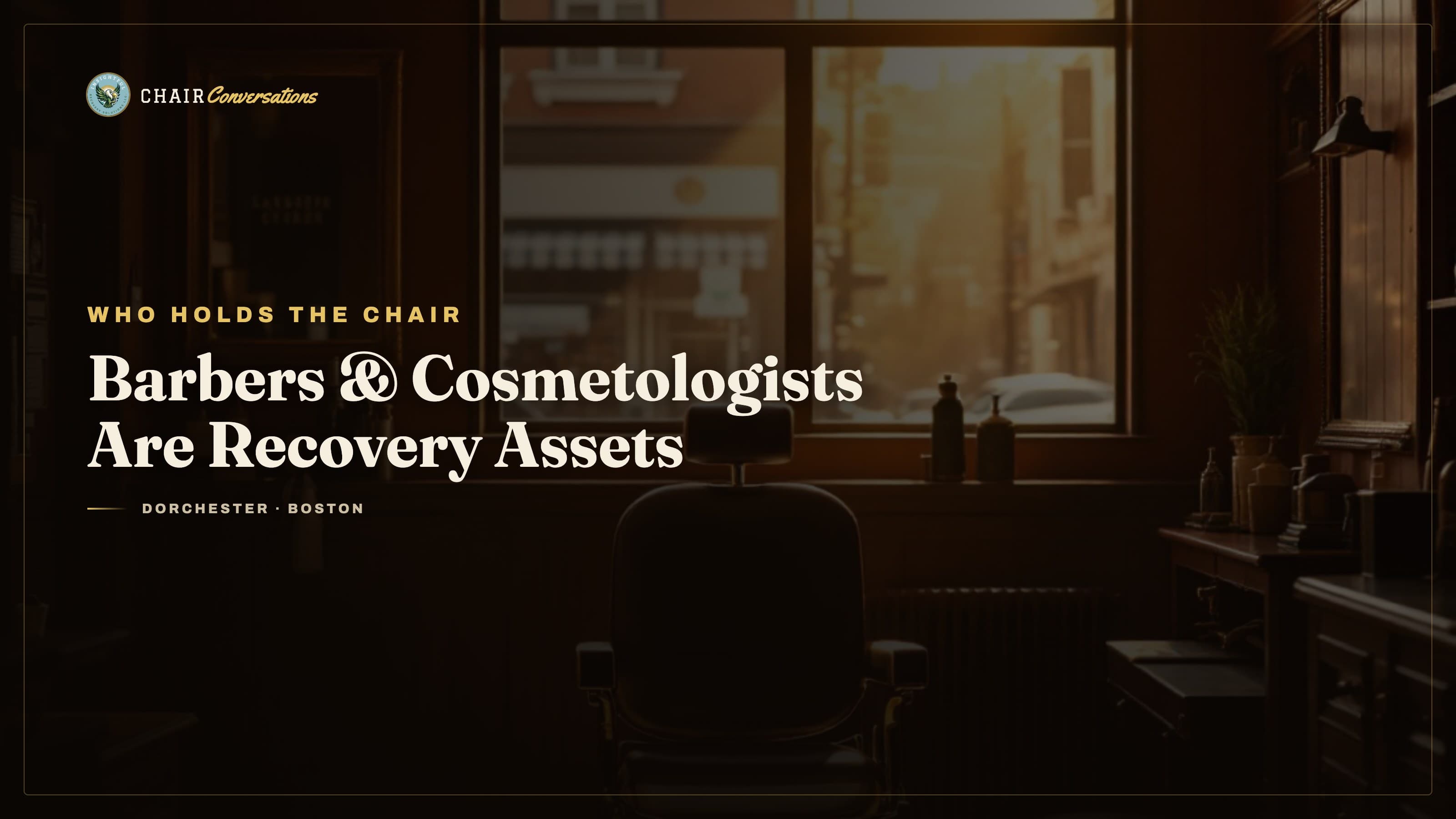
The most trusted seat in the neighborhood was never in a clinic.
It's in a shop. It's the chair a man has sat in every two weeks for fifteen years. The one where he talks about his marriage, his money, his father, the thing he hasn't told anybody else. The person holding that chair already knows more about that man's real life than most professionals ever will.
The field calls that person a service provider. I call them something else.
A Recovery Asset.
Not a volunteer. Not a room we borrow. A contributor — someone who already carries trust the whole system is starving for. When we talk about who holds the chair, we mean barbers and cosmetologists both. Cuts, hair, nails, wellness. Anybody in the community whose hands people already put their trust in. And I want to name exactly why that work matters, because it operates on three levels at once.
Level One — The Craft
Start at the ground floor: hygiene.
This is the baseline, and it's not small. A fresh cut. A line-up. Hair and nails done right. The work of looking like yourself again. Anybody who's been in the chair after a long stretch of not caring for themselves knows what happens in that moment — you sit down one way and stand up another. Something in the posture changes.
Hygiene is where dignity gets rebuilt with the hands. It's the first honest signal a person sends themselves that they're worth the care. Never skip past it as “just” a cut. For a lot of people, that chair is the first place in a long time somebody touched them with intention and told them they looked good. That's the foundation everything else stands on.
Level Two — A Trusted Community Purpose
Then there's the role.
The person in that chair isn't only cutting hair. They're holding a social position that took years to earn and can't be handed out with a certificate. In a lot of neighborhoods, the barber and the cosmetologist are the closest thing to a standing counselor the community has — open six days a week, no appointment needed to be heard, no file, no diagnosis waiting at the end of the conversation.
Trust already lives there. That's the whole point. You cannot install trust into a new program no matter how good it is. It gets built one visit at a time, over years, in a place people chose on their own. The chair is where the community already tells the truth. We're not creating that. We're honoring it — and asking the person who holds it to keep doing what they already do, with a little more intention behind it.
Level Three — A Higher Calling
And then there's the deepest level, the one most systems never see.
Some of the people holding these chairs know their work is bigger than the service. They see it as a calling. They already carry the neighborhood's stories, the grief and the wins, and they hold it because somebody has to. They've been doing community health work for years without the title, without the funding, without anybody from the outside ever noticing.
That's not a nice add-on to the craft. For a lot of them, it's the reason they do the craft at all. When you meet a barber or cosmetologist operating on that third level, you're not looking at someone who might help a recovery effort. You're looking at someone who has been one this whole time.
Contributors, Not Facilitators
Here's where The Chair Conversations™ does something different.
Most programs would use that trust as a delivery route — put an expert in the shop, borrow the credibility, run the script. That treats the barber like a hallway. A way to get somewhere else.
We don't do that. In our model, barbers and cosmetologists are content contributors. They tell their own story. How they came to value hygiene. What craft wisdom they carry. What they've learned in twenty years of listening to people in that chair. Their voice becomes part of the curriculum, captured into the book and the app right alongside the framework itself. We're not using their platform. We're building with them on it.
That's the difference between a facilitator and an asset. A facilitator moves the program along. An asset is part of the value. When a man sits down and hears the person holding the chair speak from real life about care, discipline, and coming back from something — that's not a warm-up act for the professional. That's the intervention. Engagement Is The First Intervention™, and the person in that chair is the first one to make it.
And when someone in that chair opens up and wants the next step, nobody gets handed a flyer. We do the warm handoff — person to person, into more support, never a pamphlet. The barber doesn't become a counselor. They stay exactly who they are. That's the power of it.
Meeting Health Where It Already Lives
Everything here comes back to one belief.
“We are not bringing health to the community — we are meeting health where it already lives.”
Health already lives in that shop. The trust, the honesty, the care done with two hands, the person who's been quietly holding the neighborhood together for years. Our job was never to import health from the outside and deliver it. It was to recognize the Recovery Assets already standing in the room — and finally build something with them instead of around them.
The chairs are already full of the right people. They've been doing this work the whole time. We're just naming it, backing it, and giving it a system.
Hold a Chair With Us
The Chair Conversations pilot runs four Mondays — July 20, July 27, August 3, and August 10, 2026 — at Flipping Clippers Barbershop, 483 Washington St, Dorchester, MA. This is the beginning, not the whole thing.
If you're a barber, a cosmetologist, or you run a shop — and you already know your chair is more than a chair — this was built for you. You won't be asked to become a counselor. You'll be recognized as what you already are: a Recovery Asset your community already trusts, with a story worth capturing and a purpose worth backing.
The neighborhood already sits in your chair. Let's do the deeper work from it, together.
Your chair is more than a chair.
Barbers, cosmetologists, shop owners — become a Chair Conversations™ partner.
Become a Chair PartnerDisclaimer: This content is not medical advice. Insightful Recovery Solutions provides non-clinical recovery support services. The information in this article is educational and peer-oriented — it does not replace professional medical care, therapy, or treatment. If you are experiencing a mental health crisis, thoughts of self-harm, or a medical emergency, call 988 (Suicide & Crisis Lifeline), contact SAMHSA's National Helpline at 1-800-662-4357, or go to your nearest emergency room.